

Development of a large pretrained model for Tesorai Search
Peter Cimermancic was invited to give a lecture at MaxQuant Summer School, a long-running bootcamp for mass spec proteomics analysis. He talks about outstanding challenges in the field and how Tesorai Search uses AI to overcome them.
Watch his seminar: https://www.youtube.com/watch?v=RMVboOlBaLk
AI-generated summary of Peter’s seminar
Peter Cimermancic, co-founder of Tesorai, introduces Tesorai Search, a new platform for computational mass spectrometry data analysis. He highlights significant data loss (up to 75% of spectra) during initial pre-processing in mass spectrometry due to older software and overfitting issues in "Gen 2" AI/ML algorithms (0:33-2:25, 6:24-12:02).
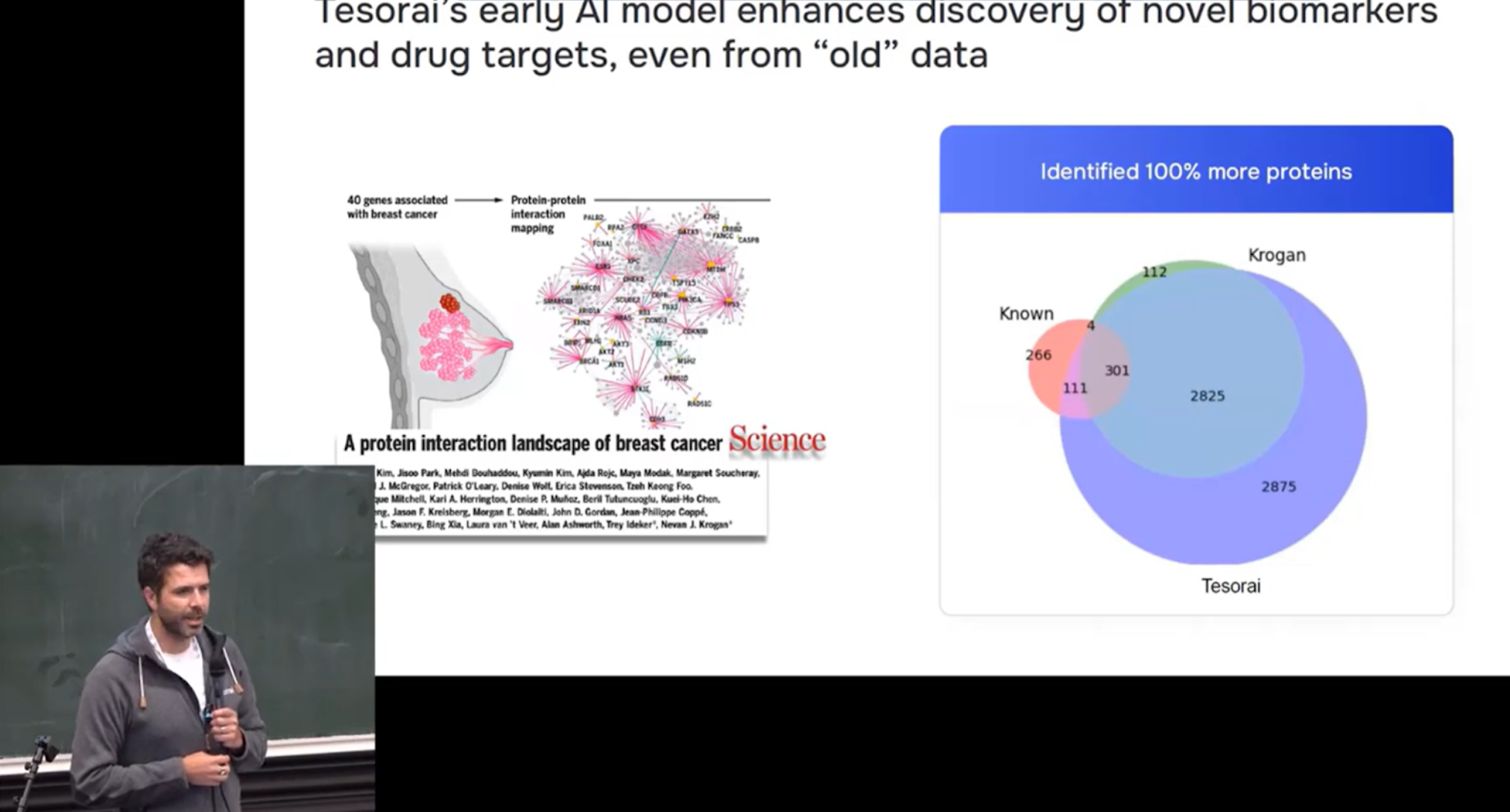
Tesorai's solution is a single, end-to-end, entirely pre-trained AI model designed to accurately identify peptides without common overfitting problems (12:03-16:32). This "Gen 3" approach boosts peptide identifications by 5% to 90% across various datasets, shows strong generalizability across different instruments and sample types, and leads to the discovery of significantly more proteins, validated by human experts and increased overlap with known biological interactions (16:33-23:48).
The Tesorai Search platform is a user-friendly, scalable, cloud-based web application that processes hundreds of files in less than an hour (23:53-27:52). Future plans include "Instant Search" for near-real-time results and "Incognito Search" to utilize 100% of spectral data for differential analysis, dramatically increasing biomarker discovery potential (28:19-31:20).
Explore more resources


Publications
Tesorai Search: Cloud-based Database Search Engine Boosts Identifications for Mass Spectrometry Proteomics With a Pretrained Peptide-spectrum Deep-learning Model
Tesorai Search is now peer-reviewed and published in the Journal of Molecular Biology, detailing the model's design and benchmarking against other leading proteomics search engines.
.svg)