

Publication
Tesorai Search: Cloud-based Database Search Engine Boosts Identifications for Mass Spectrometry Proteomics With a Pretrained Peptide-spectrum Deep-learning Model
Tesorai Search is now peer-reviewed and published in the Journal of Molecular Biology, describing the implementation of Tesorai Search, including detailed benchmarking of Tesorai against other leading software across multiple datasets.
Read the paper: https://doi.org/10.1016/j.jmb.2026.169940
Abstract
The original mass spectrometry search engines used simple algorithms for peptide identification. Recent tools improved accuracy by adding several extra components such as fragment ion intensities or retention times prediction and training target-decoy classifiers on-the-fly, leading to sometimes inconsistent results.
Our study explores the impact of replacing those extra components with a deep-learning pretrained model that directly learns the complex relationship between the full spectra and associated peptide sequence, without using decoys. This simplified workflow has fewer parameters to tweak, making it easier to use and perform robustly on data from instruments and use-cases never seen during training.
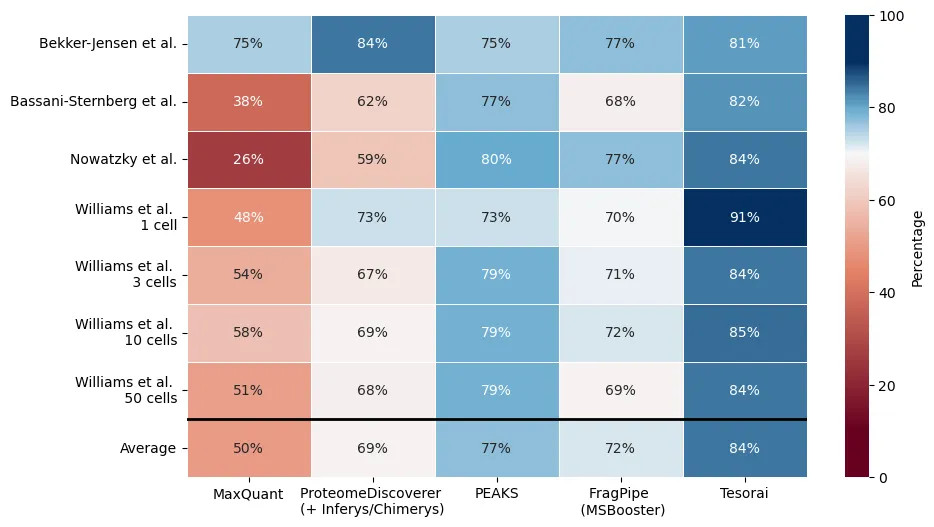
Surprisingly, our approach consistently identifies more peptides than FragPipe, PEAKS, and Proteome Discoverer (12%, 9%, and 21% more, respectively, across a range of datasets). Tesorai Search is also fast – 250 immunopeptidomics searches in 45 minutes – and free for academics, available as a webserver at console.tesorai.com.
Explore more resources



Publications
Rapid Mechanistic Bridging of an Alzheimer's Disease Plasma Protein Staging Panel Across Brain Proteomics Cohorts
Five public brain proteomics cohorts, reprocessed on Tesorai, support a seven-protein blood panel for Alzheimer's staging, including recovered p-tau217. Presented at HUPO 2026.
.svg)