

How Tesorai Works: Match-Between-Runs
Match-between-runs (MBR) recovers peptide identifications that are missing from some runs of a multi-run experiment. This article describes how Tesorai Search does this for DDA and DIA data. For the scoring model and FDR methodology behind Tesorai Search, see How Tesorai Works. For a plain-language introduction to MBR, see FDR, Match-Between-Runs, and Immunopeptidomics.
MBR is optional in Tesorai Search; for DDA it is off by default and enabled per job. The published Tesorai Search benchmark results were generated with MBR off.
Why identifications go missing between runs
A peptide identified in most runs of an experiment is often missing from a few others. The gap does not by itself mean the peptide was absent. In DDA, the instrument fragments only the precursors it selects from each survey scan, so a peptide can be present at the MS1 level without a fragment spectrum that supports an identification. In DIA, every precursor in the scanned mass range is fragmented, but the first search may not have scored a candidate for every peptide, and some signals are faint or obscured by interference.
The two acquisition modes leave different evidence in the run with the gap, so Tesorai handles them differently. In DDA, a recovered peptide is supported by an MS1 feature measured in the receiving run, with its identity transferred from other runs. In DIA, a recovered peptide is rescored against fragment data from the receiving run and passes the same FDR calculation as every other identification.
How Tesorai handles DDA transfers
DDA fragments only the precursors it selects. A peptide missing from a run often has no fragment spectrum there, and any spectrum that was recorded did not support an identification in the first search. Tesorai's DDA MBR therefore matches an MS1 feature and transfers the identity, with these safeguards:
- Source identifications must pass 1% FDR, by default in at least three runs.
- Retention-time alignment is fitted robustly, and the matching tolerance comes from each run's own retention-time spread.
- Decoy transfers are carried alongside real ones.
- When the job has enough calibration data, an acceptance model is trained on the job's own labelled examples, with a cutoff set to target a wrong-transfer rate of about 1%.
Small jobs. The source requirement is capped at one fewer than the number of runs: a three-run job needs two source runs, and a two-run job allows one source with no cross-run corroboration. If there are too few labelled examples to calibrate, acceptance falls back to permissive rather than rejecting all transfers. Small jobs still get MBR, without a calibrated cutoff.
In every case, the evidence in the receiving run is an MS1 feature, not a fragment spectrum. The DDA technical post describes the acceptance model and its calibration.
How Tesorai verifies DIA recovery candidates
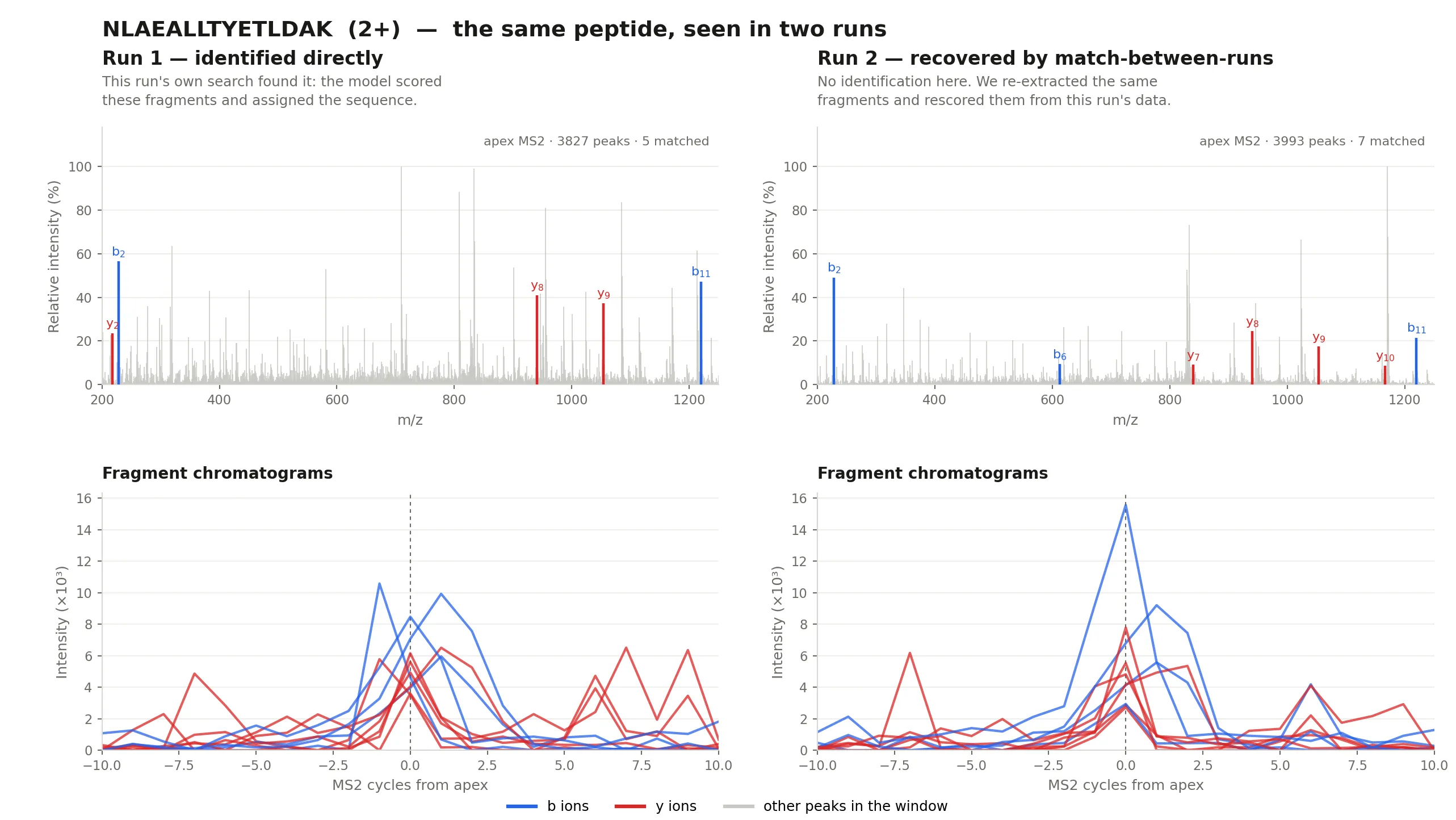
DIA fragments everything within the scanned mass range on every cycle, so the receiving run has fragment data covering each candidate's mass and expected elution time. Whether those data hold usable evidence for the peptide is what Tesorai tests:
- Propose. Peptides confidently identified in several source runs but missing from another become candidates, each with a predicted retention time and, where measured, ion mobility. Decoy candidates are proposed alongside them.
- Extract. Fragment chromatograms for each candidate are extracted from the receiving run, with the same code and tolerances as the main search.
- Score. The same DIA model that scores every other identification scores them.
- Control error. Recovered and direct candidates, targets and decoys alike, share one FDR calculation.
- Quantify. Each recovered precursor is quantified from its own signal in its own run.
Candidates without supporting fragment signal are not rejected automatically: they must pass the same scoring and FDR threshold as every other identification. That threshold controls the error rate across accepted identifications; it does not guarantee that every unsupported candidate is rejected. Each recovered identification keeps its MS2 scans, fragment chromatograms, score and q-value.
What the plasma comparison shows
In a comparison of ten human plasma DIA runs, enabling match-between-runs improved measurement completeness while adding very few new precursors to the cohort-wide set. See the DIA technical post for the full results.
The comparison describes one cohort. The effect of MBR depends on cohort size, sample type, instrument and acquisition settings.
How to recognize recovered identifications in the results
MBR-recovered identifications are marked in the output CSV and in the dashboard’s ‘is mbr’ column.
Because DDA and DIA recoveries rest on different evidence, it helps to note which acquisition mode a recovered identification comes from when interpreting it. For full method details, see the technical posts on MBR in DDA and MBR in DIA.
See how Tesorai Search compares
Explore more resources

Publications
Tesorai Search: Cloud-based Database Search Engine Boosts Identifications for Mass Spectrometry Proteomics With a Pretrained Peptide-spectrum Deep-learning Model
Tesorai Search is now peer-reviewed and published in the Journal of Molecular Biology, detailing the model's design and benchmarking against other leading proteomics search engines.

Publications
Rapid Mechanistic Bridging of an Alzheimer's Disease Plasma Protein Staging Panel Across Brain Proteomics Cohorts
Five public brain proteomics cohorts, reprocessed on Tesorai, support a seven-protein blood panel for Alzheimer's staging, including recovered p-tau217. Presented at HUPO 2026.
.svg)