

How Tesorai Works
Now peer-reviewed and published in the Journal of Molecular Biology (2026).
Tesorai Search is built to be fast, scalable, and easy to use, without asking you to trade off rigor to get there.
Effortless scalability
Handle projects of any size without worrying about local computing limitations. Tesorai Search runs in the cloud, not on a single computer, so instead of processing samples one at a time on a lab workstation, it spins up as many machines as needed to analyze every file at once. Reprocessing 250 immunopeptidomics files, a task that could take days locally, finishes in under 45 minutes on our platform — and that speed holds as your data grows, rather than slowing down.
Enhanced collaboration
Cloud-based processing means analyses can be easily shared with your collaborators.
Easy to use
Upload raw data, set a couple of parameters, and you're good to go. No complex software installations or high-performance hardware needed. Whereas some tools require tuning dozens of parameters (precursor and fragment mass tolerance, isotopes, RT window, etc), we automatically adapt defaults to the instrument being used.
One model, one score
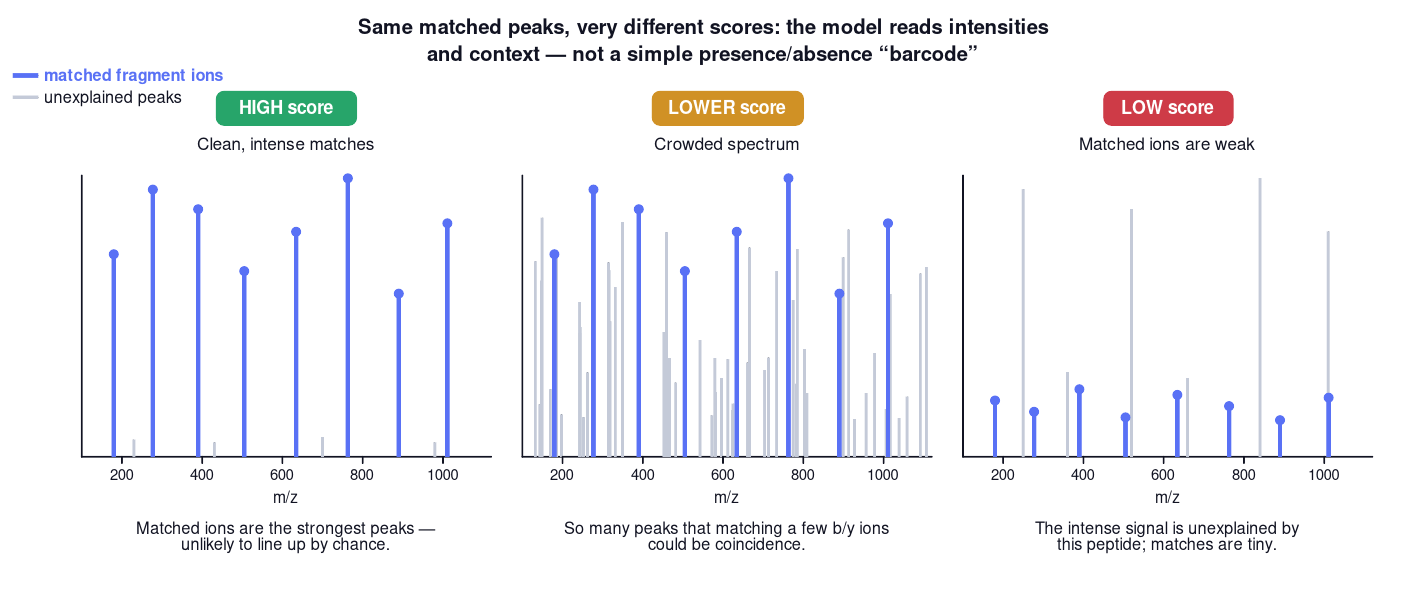
The single most important thing to understand about Tesorai Search is that the extra identifications do not come from a looser threshold on a familiar score. They come from a different score — one produced by a single model that looks at the entire spectrum and the candidate peptide together and asks one question: does this spectrum really come from this peptide?
Concretely, the model lays out the chemistry of the candidate peptide, reads the entire measured spectrum, and judges the agreement between the two — comparing the predicted fragment layout against the measured peaks and weighing how well the intensities and positions line up to produce a single score.
Built-in, honest FDR control
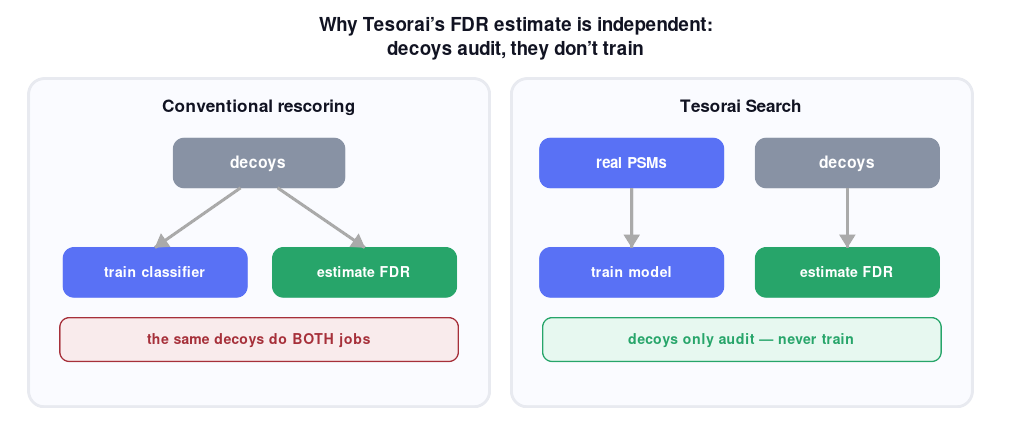
Most modern tools ask their decoys to do two jobs at once: teach a classifier what "wrong" looks like, and estimate the error rate. We ask decoys to do only one. The part of Tesorai Search that decides whether a spectrum matches a peptide never sees a decoy — decoys are held back entirely for measuring the error rate afterward, so the estimate stays independent of the model that produced the score.
Built for both DDA and DIA
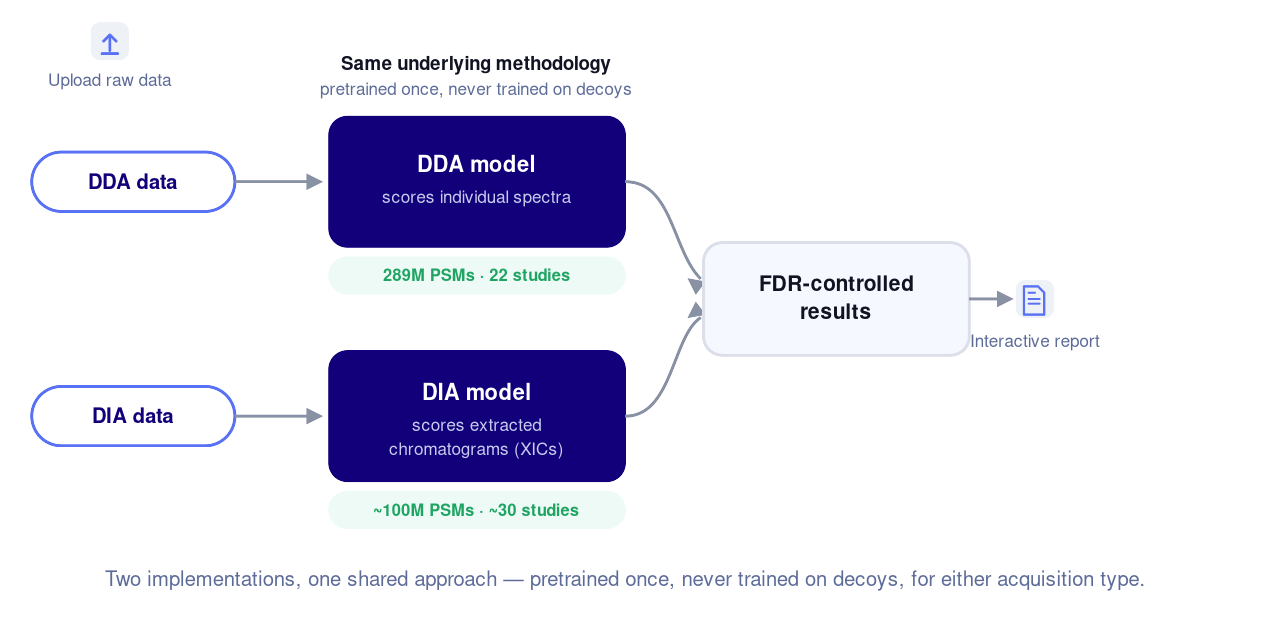
Traditional search engines are typically built for one acquisition strategy or the other. Tesorai Search supports both DDA and DIA on the same core methodology: a model pretrained once on hundreds of millions of real peptide-spectrum matches, and never trained on decoys. The DDA and DIA models are separate implementations tuned to their data — DDA scores individual spectra, DIA scores extracted chromatograms (XICs) — but they share the same underlying approach, so you get one consistent, high-confidence tool regardless of how your data was collected.
More peptides, honest error rates
Tesorai Search identifies, on average, 9% to 68% more peptides than other current search engines at a 1% FDR, comparing across four widely used tools, on seven independent datasets it never saw during training — peer-reviewed and published in the Journal of Molecular Biology.
These gains hold up under scrutiny. Tested with an entrapment analysis — a foreign protein database spiked into the search, so any match to it is a guaranteed false positive — the measured error rate closely tracked the target FDR across thresholds from 0.1% to 10%, rather than falling arbitrarily below it. In other words, when Tesorai Search says 1% FDR, the observed error rate is close to 1%, not inflated, and not artificially conservative either.
How we handle protein inference
Protein inference in Tesorai Search follows standard, well-established methods — protein groups and razor-peptide assignment, the same approach used since the original MaxQuant inference model.
See how Tesorai Search compares
Explore more resources

Publications
Integrating Narrow-Window DIA with AI-Powered Search Enables Deep and Reliable Functional Proteomics
Our collaborators at MD Anderson Cancer Center have deposited a preprint on bioRxiv benchmarking narrow-window DIA with Tesorai Search, achieving the deepest proteome coverage among 12 acquisition-analysis pipelines tested while maintaining rigorous FDR control.
Publications
Rapid Mechanistic Bridging of an Alzheimer's Disease Plasma Protein Staging Panel Across Brain Proteomics Cohorts
A new Tesorai preprint validates a proposed seven-protein blood biomarker panel for Alzheimer's staging by reanalyzing five independent brain proteomics cohorts, recovering a key biomarker, p-tau217, that was missing from the original studies.
Publications
Single-cell foundation models benefit from cross-modal training: adding proteomics data beats parameter scaling
Fine-tuning a single-cell foundation model on proteomics data matches or beats scaling to models over 40x larger — showing multimodal training can outperform parameter scaling alone.
.svg)
Insights leveraging every byte of raw data