

Revealing the Functional Landscape of RNA Editing
Study at a Glance
The Challenge
RNA editing allows cells to alter protein sequences without changing the underlying DNA sequence. In cephalopods, previous studies had identified approximately 87,000 non-synonymous RNA editing events at the transcript level. However, only 432 editing sites had been verified at the protein level, leaving most of the functional consequences of RNA editing unexplored.
The UCSF team set out to create a proteome-scale map of RNA editing and understand how these edits influence protein function, stability, localization, and post-translational modification.
The core challenge: Achieving that goal required analysis of approximately 10 TB of mass spectrometry data while maintaining high confidence in variant detection and controlling false discoveries across thousands of candidate editing events.
The Approach
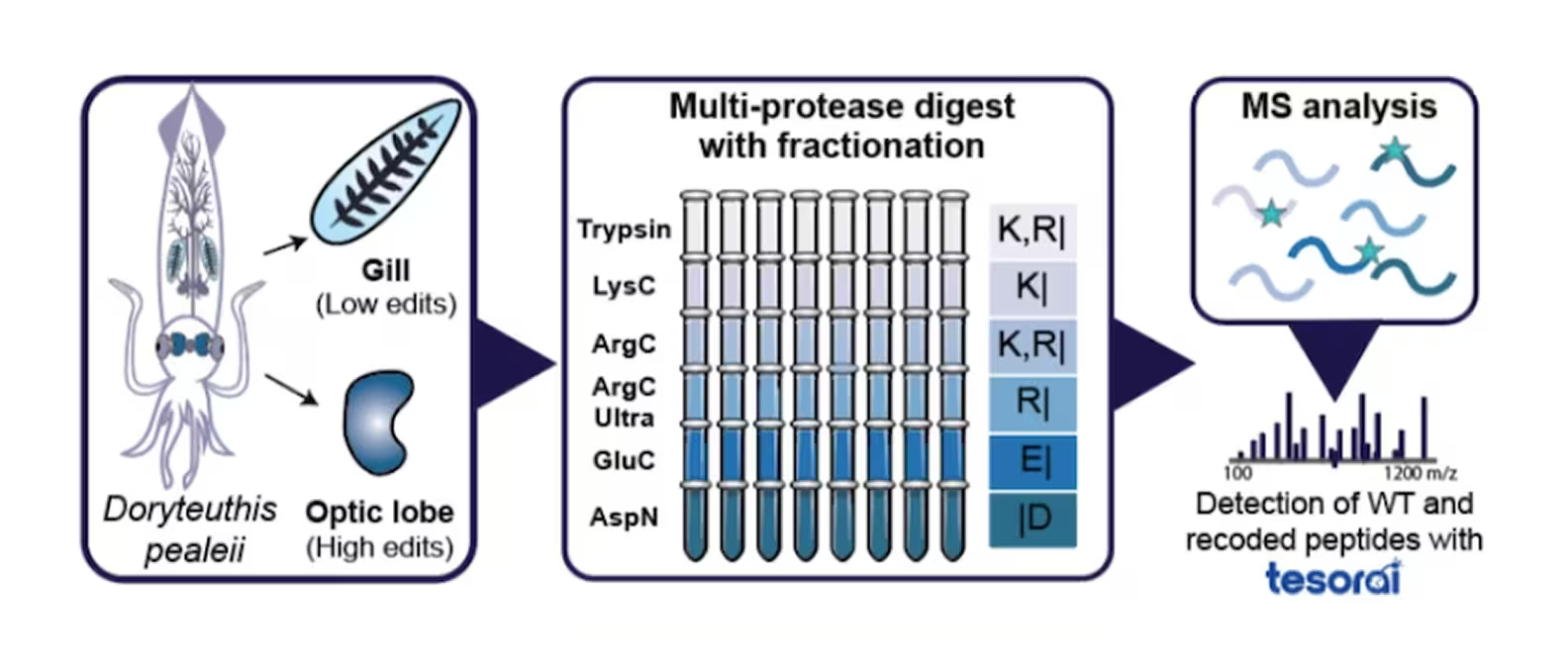
Researchers analyzed optic lobe and gill tissue from Doryteuthis pealeii using a deep proteomics workflow that combined:
- Multiple proteases to maximize sequence coverage
- Extensive peptide fractionation
- High-resolution mass spectrometry
- Tesorai Search for peptide identification and variant detection
The workflow combined deep proteomic coverage with Tesorai Search to identify both wild-type and RNA-edited peptide sequences across multiple tissues and protease workflows.
Results
The study identified
- 7,998 protein-verified RNA editing sites
- 2,091 proteins containing edited sequences
- An 18× increase over previously reported protein-level evidence
Compared with the 432 protein-verified RNA editing sites previously reported, the study expanded protein-level evidence for RNA editing by approximately 18-fold.
Beyond cataloging editing events, the research demonstrated that RNA editing can alter protein stability, localization, enzymatic activity, and post-translational modification, providing new insight into how cephalopods diversify protein function.
"Tesorai's ability to detect sequence variants was remarkably accurate. It was far better than other tools we've tried. And the processing speed was just as impressive."
Jack Moen
UCSF
Impact
By combining deep proteomics with AI-enabled peptide identification, UCSF researchers expanded protein-level evidence for RNA editing from 432 previously reported sites to 7,998 verified sites across 2,091 proteins.
The resulting resource provides one of the most comprehensive proteomics-supported maps of RNA editing reported to date and establishes a foundation for studying how RNA editing influences protein function, cellular adaptation, and evolution.
The work demonstrates how advances in computational proteomics can reveal biological signals that were previously inaccessible using conventional analysis approaches.
Published: Functional Diversification of the Cephalopod Proteome by RNA Editing (2025)
Read more on our Publications page.
Explore more resources


Publications
Tesorai Search: Cloud-based Database Search Engine Boosts Identifications for Mass Spectrometry Proteomics With a Pretrained Peptide-spectrum Deep-learning Model
Tesorai Search is now peer-reviewed and published in the Journal of Molecular Biology, detailing the model's design and benchmarking against other leading proteomics search engines.
.svg)