

Tesorai Trove · Oncology research
Explore cancer proteomics data to investigate your next candidate.
Investigate therapeutic targets, biomarker candidates and disease mechanisms with public cancer proteomics data. Find relevant datasets, explore proteins with Tesorai Chat, and compare evidence across studies, without downloading raw files or rebuilding analysis pipelines.
In practice · Colorectal cancer research
Where does your candidate show a signal—and does it hold up across studies?
Whether you’re prioritizing a target, evaluating a biomarker candidate or investigating a mechanism, protein-level evidence adds context. Using Trove and Tesorai Chat, we examined OLFM4 across three public colorectal cancer proteomics cohorts.
Research question
Is OLFM4 more abundant in colorectal tumors than in matched non-tumor tissue?
One candidate. Three cohorts. A fuller picture.
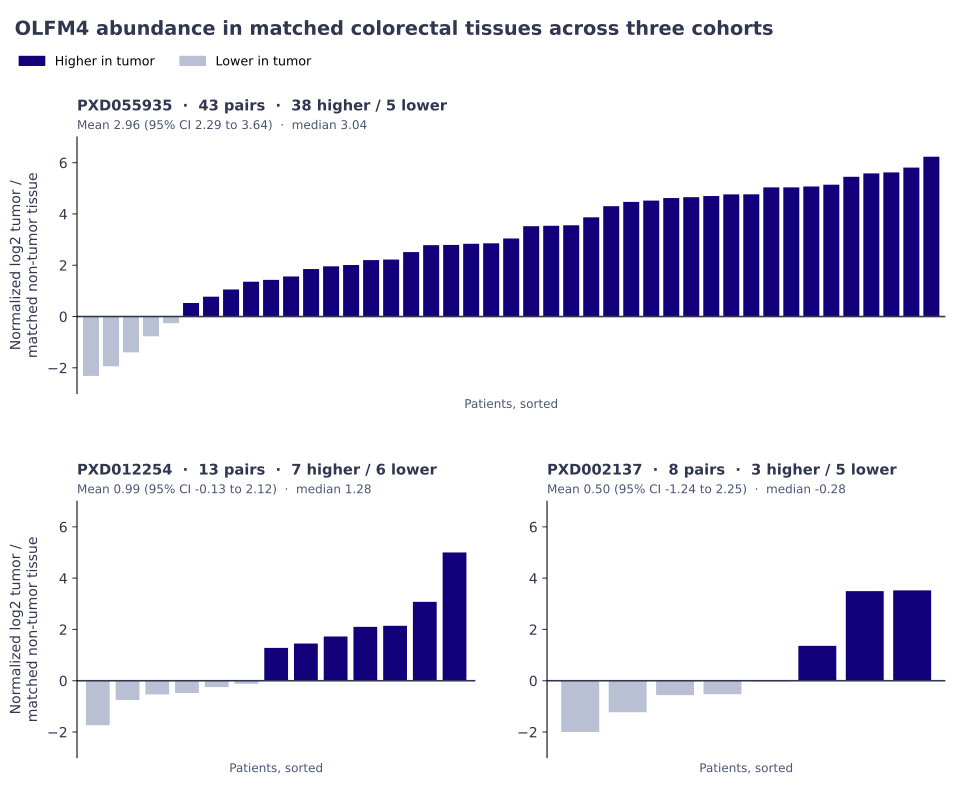
OLFM4 was higher in tumor tissue in 38 of 43 evaluable patients in the first cohort. The second cohort showed a mixed, positive-leaning pattern. The third showed an uncertain result, with a few large increases alongside more frequent decreases. Confidence intervals for the mean change included zero in both smaller cohorts.
Bring protein-level evidence into your next research decision.
Explore where a candidate protein is measured, how its abundance differs between conditions, and whether a pattern recurs across studies. Use that evidence to inform target prioritization, biomarker research and questions about disease mechanisms.
Study context
This is an illustrative reanalysis of published tissue proteomics data, not clinical biomarker validation. The cohorts differ in tissue preparation and measurement methods. These tissue-level measurements do not establish which cell types express OLFM4.
Analysis details and sources
Figure caption
Each bar represents one patient’s paired log2 difference in OLFM4 abundance between tumor and matched non-tumor tissue after sample-median centering. Studies were analyzed separately; missing measurements were not imputed. Analyzed pair counts: 43, 13 and 8.
Datasets and publications
PXD055935 · Advanced Science, 2025
Companion global proteome of an N-glycoproteomics study of 45 colorectal tumors with matched normal adjacent tissue. Label-free DDA, bulk frozen tissue. 43 of 45 pairs analyzed: two pairs were excluded because OLFM4 was not detected in the normal adjacent sample.
PXD012254 · International Journal of Cancer, 2019
DIA, fresh-frozen tissue; 13 pairs linked by clinical patient ID. The comparison tissue is donor-matched non-tumor tissue, which the authors describe as taken adjacent to colorectal neoplasia (an adenoma, a carcinoma or both), so it was not necessarily adjacent to the carcinoma. Excluding one pair whose tumor and non-tumor samples came from different colon segments did not change the result.
PXD002137 · Journal of Proteome Research, 2015
Label-free DDA, laser-microdissected FFPE epithelium; 8 patient-matched cancer and normal mucosa pairs from the authors’ clinical table.
How the analysis was done
The three studies were chosen before any OLFM4 result was seen, and none was added or dropped based on its result. Within each study, log2 OLFM4 intensity was centered on each sample’s median protein intensity, and a pre-specified two-sided paired t-test gave the mean difference with a 95% confidence interval. No values were imputed and no pooled estimate was made. Without median centering, the two smaller cohorts’ confidence intervals still included zero.
Analysis by Tesorai. Metadata review, OLFM4 mapping, patient pairing, normalization and all statistics were performed in Tesorai Chat on Trove datasets. The figure was generated, and every statistic recomputed, outside Tesorai from the exported per-patient tables; all recomputed values matched. Steps that need the full data matrices (OLFM4 extraction, sample medians and pairing) were performed in Tesorai only.
From a research question to an analysis.
Find relevant datasets
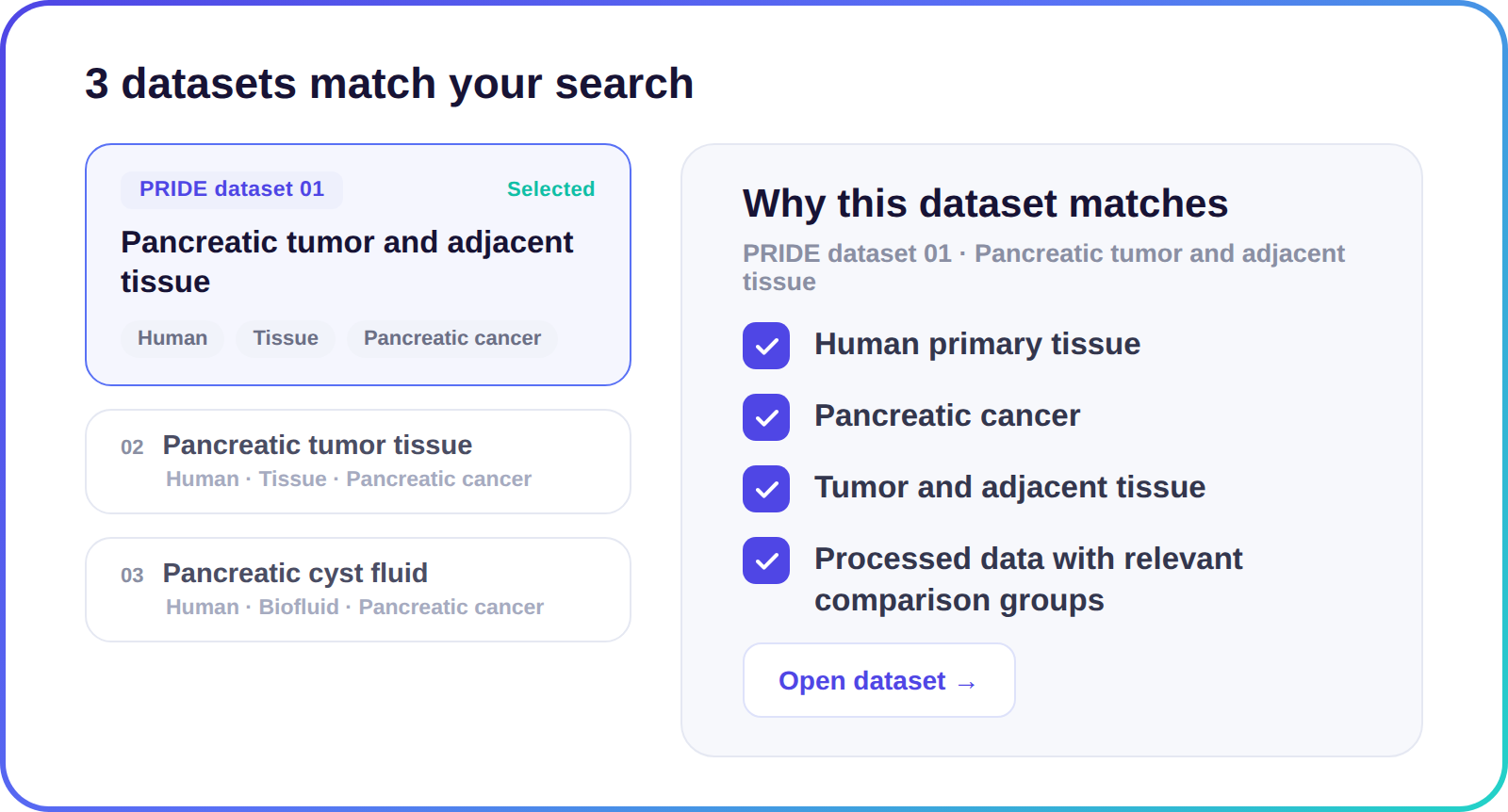
Search Trove by disease, tissue and study context.
Explore in Chat
Open a selected dataset in Tesorai Chat to compare conditions and investigate proteins of interest.
Compare findings
Bring selected datasets into Chat to explore where biological patterns recur and where the evidence differs.
Frequently asked questions
Do I need my own mass spectrometry data?
No. Trove lets you explore existing public proteomics datasets.
Do I need to download raw files?
You can explore the processed datasets available in Trove directly through Tesorai Chat.
Can I compare findings across studies?
Yes. You can bring selected Trove datasets into Chat to investigate similarities and differences. Interpretation should account for each study’s design and sample context.

Bring your next target, biomarker or mechanism question to Trove.
Find relevant public cancer proteomics datasets and investigate the evidence with Tesorai Chat.
