

Tesorai Trove · Neurological disease research
Explore neuro proteomics data for biomarker research.
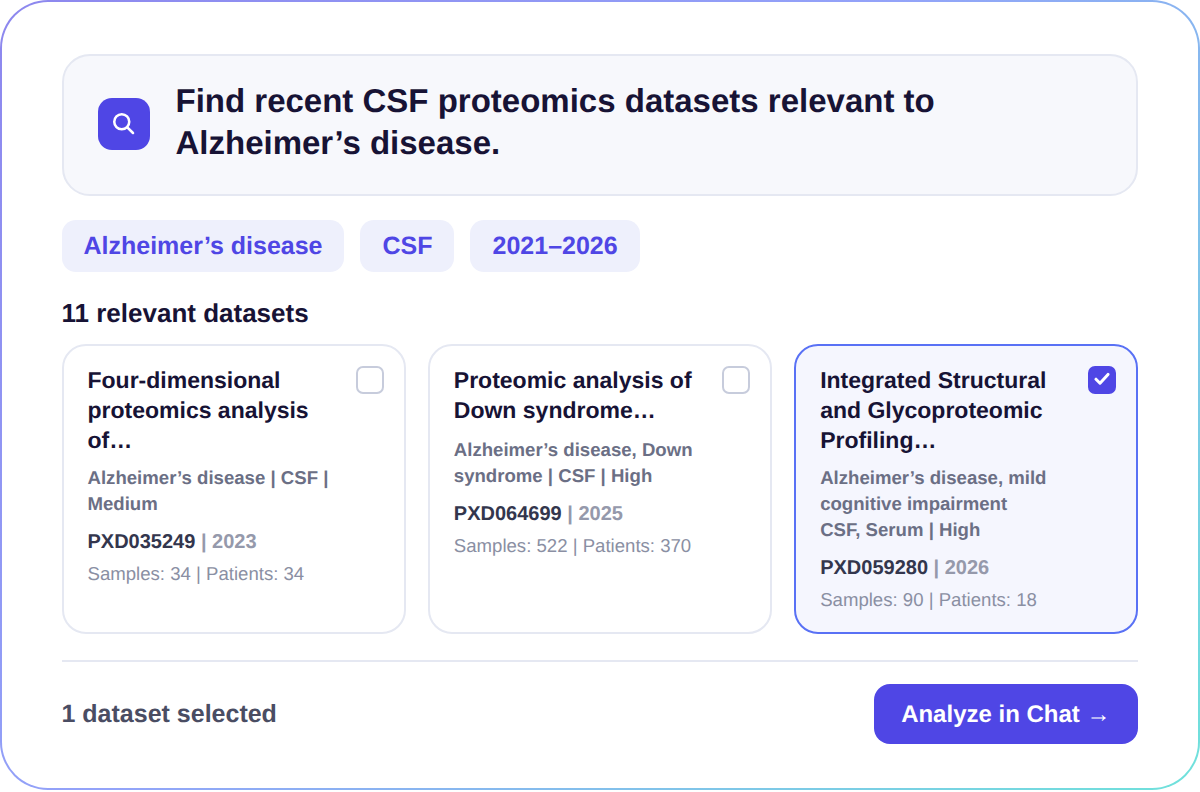
Find relevant public neurological disease datasets, investigate candidate proteins with Tesorai Chat, and compare findings across studies without downloading raw files or rebuilding analysis pipelines.
In practice · Alzheimer’s biomarker research
Five public cohorts. One new biomarker question. A preprint in 25 days.
When a new Alzheimer’s plasma-protein staging panel was published, Tesorai researchers asked: do its biomarkers also reflect molecular changes in the brain? Using public datasets available through Trove, they investigated the question across five independent brain proteomics cohorts—without collecting a new experimental cohort.
5
Independent brain proteomics cohorts
25 days
From the plasma-panel publication to a new preprint
4 of 5
Cohorts with p-tau217 recovered through Tesorai Search reanalysis
Research question
Does a plasma-derived staging panel also carry disease-stage information in brain tissue?
Using five public brain proteomics cohorts identified through Trove, researchers examined the available panel proteins, with surrogate measurements where needed. Models fitted and evaluated separately within each cohort distinguished earlier from later neuropathological stages.
AUC ranged from 0.78 to 1.00 across the five cohorts.
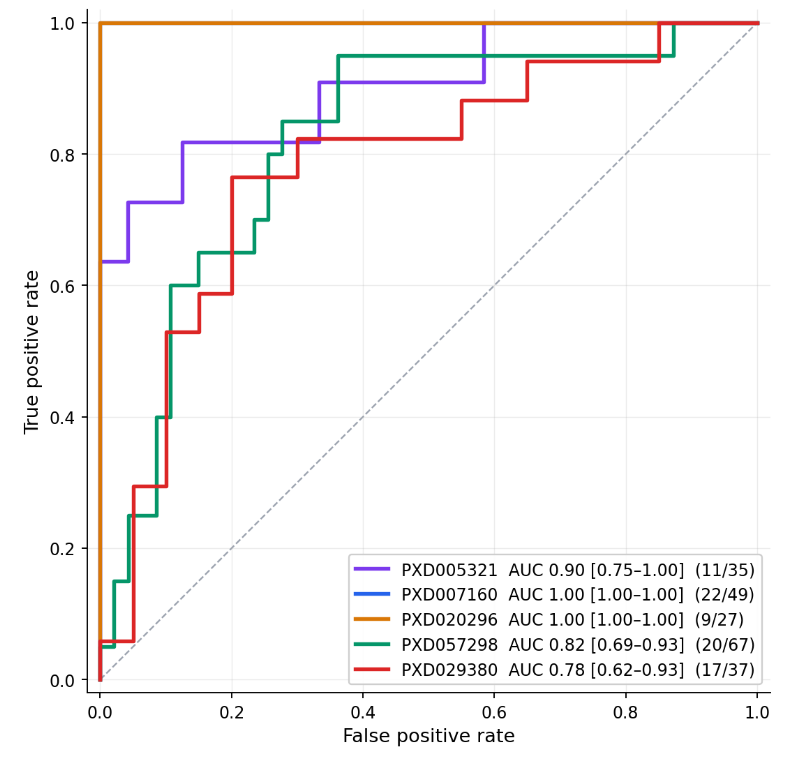
Available panel proteins distinguished early (Braak 0–IV) from late (V–VI) neuropathological stages. Each cohort was modeled independently using nested leave-one-donor-out cross-validation. Source: Kim, Kerrisk Campbell et al., Figure 3, bioRxiv preprint, September 2026; not peer reviewed.
Go deeper when protein tables leave a question unanswered.
The deposited protein summaries did not explicitly quantify p-tau217. Reprocessing the underlying raw spectra with Tesorai Search recovered this disease-relevant tau phosphopeptide in four of five cohorts, revealing evidence beyond the original protein-level tables.
Study context
This retrospective preprint analysis supports biological concordance, not prospective clinical validation. Panel coverage varied across cohorts, and the panel was not uniquely predictive relative to the broader brain proteome in every cohort.
Kim, Kerrisk Campbell, Burq et al. · Posted September 4, 2026 · Not peer reviewed.
From a research question to an analysis.
Find relevant datasets
Search Trove by disease, tissue and study context.
Explore in Chat
Open a selected dataset in Tesorai Chat to compare conditions and investigate proteins of interest.
Compare findings
Bring selected datasets into Chat to explore where biological patterns recur and where the evidence differs.
Frequently asked questions
Do I need my own mass spectrometry data?
No. Trove lets you explore existing public proteomics datasets.
Do I need to download raw files?
You can explore the processed datasets available in Trove directly through Tesorai Chat.
Can I compare findings across studies?
Yes. You can bring selected Trove datasets into Chat to investigate similarities and differences. Interpretation should account for each study’s design and sample context.

Start with a question. Find data to investigate it.
Explore relevant public proteomics datasets and continue your analysis in Tesorai Chat.
